Order

Where it beginsEight steps

It starts
in the dirt.

Every pair on this site is a plant that was grown, picked, spun, woven, cut, dyed, printed, sewn and washed. Most of that is done by hand, and none of it is quick. Here is the whole of it, in order, from the ground up.

01

A seed wrapped in fibre

Cotton is not a fabric. It is a shrub that puts out a boll — a hard green pod that splits open into a fist of white fibre with the seeds still buried in it. Everything downstream is an argument with that fist: how to get the seed out, how to get the fibre straight, how to twist it into something long enough to weave.

The soil and the water decide the staple length, and the staple length decides how soft the finished cloth can ever be. That is the part nobody downstream can fix.
02

Picked, then pulled apart

The boll is opened, the seed is separated from the lint, and the lint is combed until the fibres lie in the same direction. Done by machine this takes seconds. Done the old way it takes a morning and leaves your hands raw.

What comes out is a soft rope of loose fibre with no strength at all. It falls apart if you pull it. It only becomes thread when it is twisted.

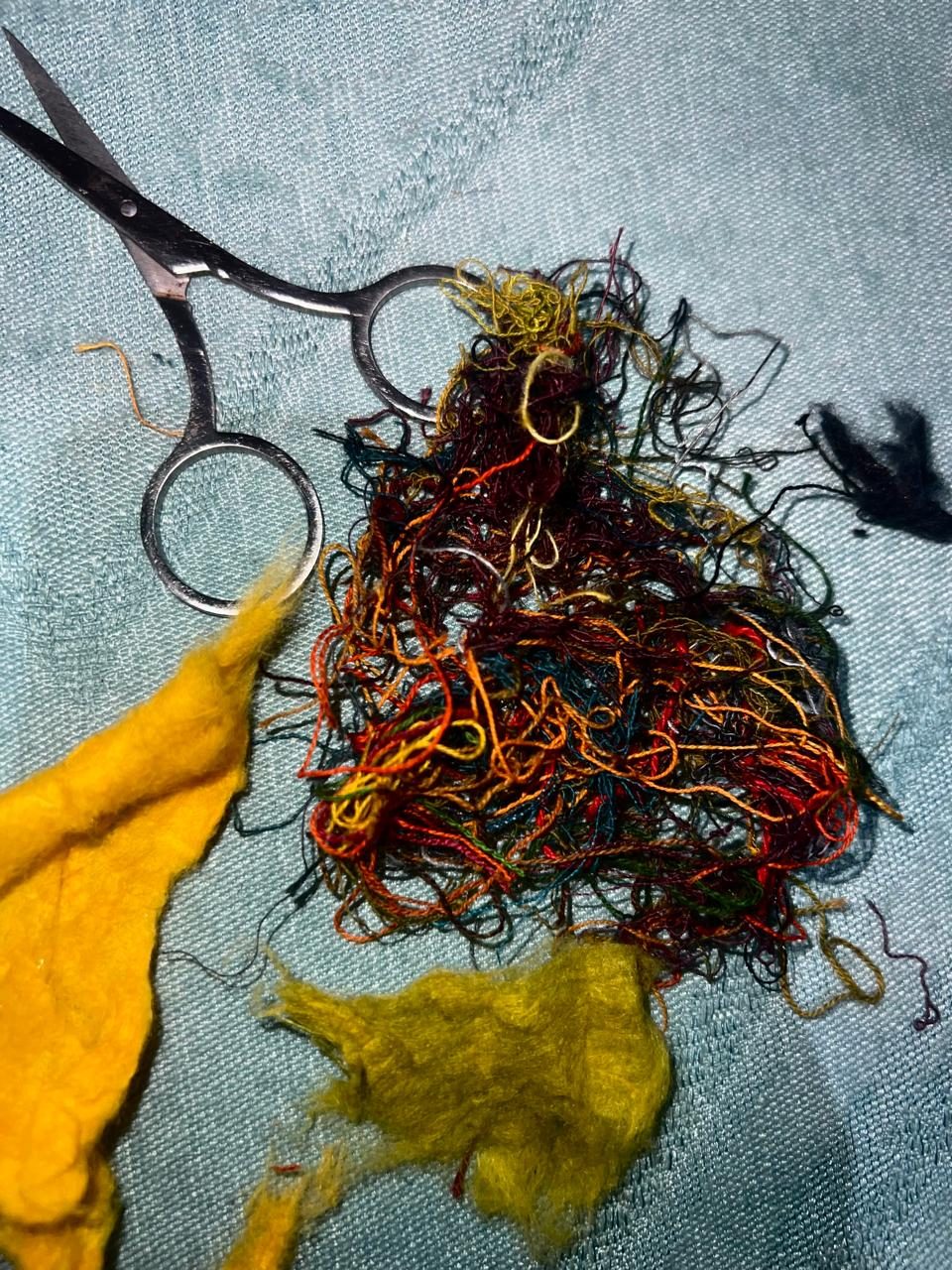
Embroidery scissors beside a nest of cut thread ends in yellow, rust, teal and red, with raw dyed cotton fluff.
The floor of the room. Thread ends in every colour on the rack, raw dyed cotton, and the scissors that made both.

03

Spun, and woven uneven

Twisted, the fibre becomes yarn. Woven, the yarn becomes khaddar — the coarse hand-loom cotton these trousers are cut from. Look closely at any panel and the threads are not all the same thickness. Some sit proud of the weave, some sink.

That irregularity is why the dye later runs in vertical stripes instead of sitting flat. A perfectly even industrial weave would take the colour perfectly evenly, and there would be nothing to look at.

04

Cut down, and kept

Cloth left over from other runs is sorted by weave and by weight. A panel too thin to take a knee goes back on the pile. A strip of woven trim gets set aside for a cargo pocket. This is where a pair actually begins as an object — not with a bolt of new cloth, but with a heap of pieces that already had another life.

It is also why no two pairs match. There is no master layout. Somebody chooses which green sits next to which red, one leg at a time.

05

Into the vat

Panels go into an open bath of dye and come out streaked along the grain. Nothing is sealed, nothing is temperature-controlled, and the same recipe on two different days gives two different greens. Some panels are dipped twice at one end, which is why a knee is often darker than a hip.

This is also the reason the first wash runs coloured. There is loose dye in the cloth because nothing was chemically forced to stay put.

06

Struck with wood

The moons, roses, butterflies, mandalas, the om and the stupa eyes are all carved into blocks of wood. The block is inked and struck onto the panel by hand, placement judged by eye.

Ink pools on the edge that got pressed hardest and starves on the edge that lifted first. On some panels a print is half off the seam. That is the mark of the hand that held it, and it is the difference between this and a screen print.

See all ten blocks →

07

Stitched, then beaten soft

Panels are joined, pockets are set, woven trim is laid over the cargo, and elastic goes into the waist and both ankles — or doesn't, on the two straight-leg cuts. Then the finished pair is stone washed: tumbled with abrasive until the cotton gives up its stiffness and the seams start to fall properly.

That wash is what makes a new pair feel like it has already been worn for a year. It is also the last chance for the colour to move before it reaches you.

08

Tagged with jute

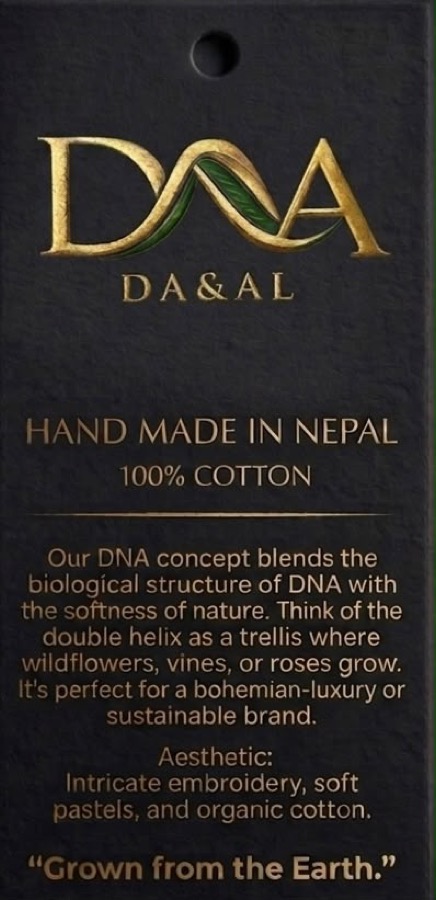
A black card, gold foil, a length of jute string through a punched hole. Hand made in Nepal. 100% cotton. Grown from the Earth.

That is the whole claim, and it is on the tag because it is the only thing worth saying: this came out of the ground, and people touched every stage of it.

The reverse of the DNA hangtag, printed with the brand's concept.

Nine of them
came out of that.

Nine baths, three cuts, and no two pairs the same — because at no point in any of the above was anything measured twice.

Your order

Total

Opens a chat with +212 653 912 591 with your pieces, the total and a photo link for each. WhatsApp cannot attach the photos for you — add them yourself if you like.